Nitro’s 2026 benchmark tracks 4.17 billion sessions and finds browser games earn more per session than any other category on its network.
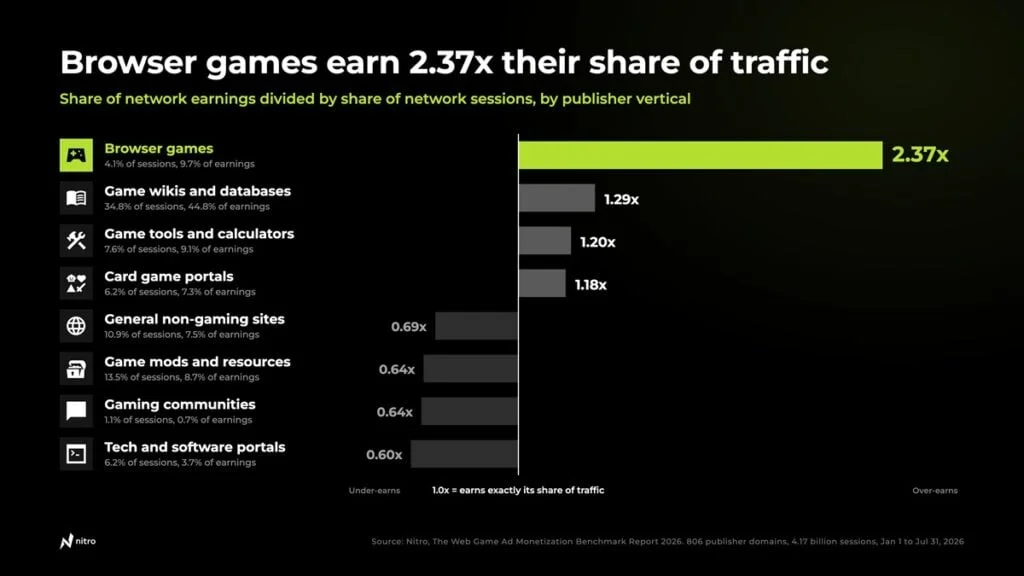
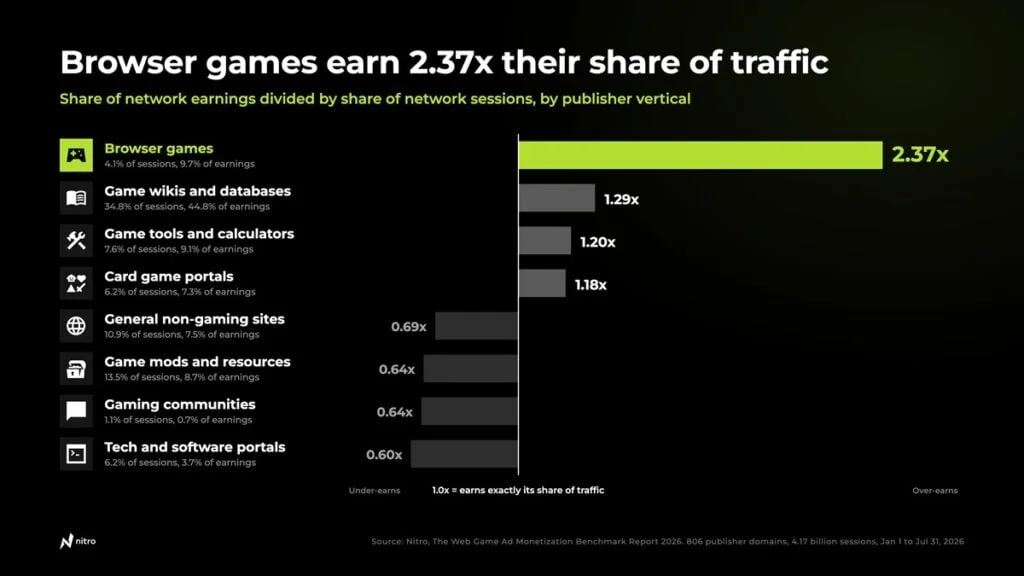
Browser games make up a small share of Nitro’s traffic but return more revenue per session than any other category on its network. That gap is the standout finding in the company’s first Web Game Ad Monetization Benchmark Report, which also charts rapid growth in browser game activity during the first half of 2026.
Nitro, Overwolf’s monetization platform for browser games and gaming content sites, analyzed 4.17 billion sessions across 806 publisher domains from January through July. The number of browser game domains on its network more than doubled in the first half of the year. Monthly sessions climbed from 18.4 million in January to 32.6 million in June, a 77.5% increase.
Browser games represented 4.1% of network sessions, yet generated 9.7% of total earnings. Their revenue per session was 176% above the network average. Nitro argues that session-based revenue is a better measure for these games than pageview-based revenue per thousand impressions: players can spend a long time in one game without loading another page.
Long sessions change the ad math
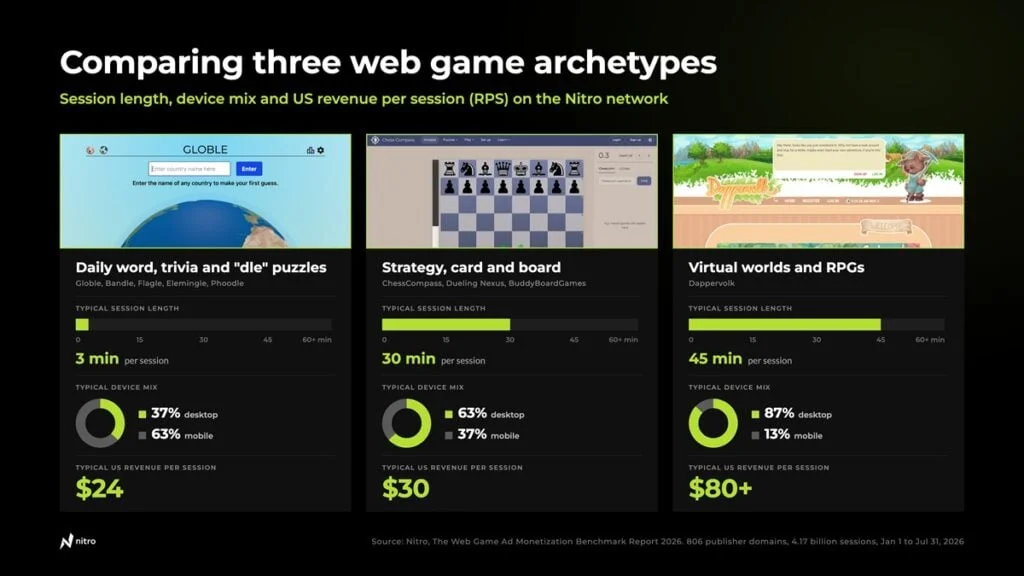
Session length varies by genre. Competitive strategy games often hold players for 15 to 45 minutes, while virtual worlds and role-playing games can reach 30 to 60 minutes or more. Titles built around daily play rituals commonly retain 40% to 50% of players on both Day 7 and Day 30, according to the report. By comparison, it says hyper-casual mobile games typically lose 70% to 80% of players by Day 7.
That time creates more opportunities for ads, provided they fit the play experience. An engaged eight-minute session can carry 8 to 12 ad impressions through IAB-compliant refreshes, compared with 2 to 3 during a two-minute visit. Placement also shaped results: sticky bottom anchors generated nearly 39% of net ad revenue, while floating video units accounted for nearly 10% of earnings despite making up fewer than 5% of active ad units.
Geography matters, too. U.S. traffic earns nearly 60% more per session than the global baseline. Persistent virtual worlds average more than $80 in U.S. revenue per session, with summer peaks above $110.
“Gaming websites behave very differently from traditional content websites, and that’s something generic ad tech doesn’t always account for,” said Nitro cofounder Cody Bye. He said the platform is designed to help publishers earn from long, engaged sessions while keeping ads from disrupting play. The aim, he added, is to make more of existing engagement rather than pack in as many ads as possible.
Control over placement remains central
Toronto-based Trainwreck Labs offers one example of a small studio building a business around browser games. Abe Train left his job as head of business intelligence at HelloFresh Canada in late 2021 to create Globle, a geography guessing game that went viral. His studio now operates 10 browser games and has generated more than $1 million in revenue without a full-time employee.
Train’s rule is to keep ads outside the playable area. “If it is a game, I have to be very careful that the ad doesn’t interfere with the gameplay,” he said. He pointed to control over ad design and placement, along with game-level performance data in the dashboard, as useful tools.
Nitro released the report alongside the Base44 x Nitro Web Game Contest, run with AI app-building platform Base44. The contest offers $65,000 in cash prizes, including a $25,000 grand prize. Submissions are open from November 5 through December 3, 2026, and top entries will appear in the Overwolf App Store. Details are at nitropay.com/base44webgame.
Availability
The full report is available at nitropay.com/webgamereport2026.
The post Browser game domains more than doubled as monthly player sessions grew 77.5% in 1H | Nitro report appeared first on GamesBeat.



Discussion
Sign in to join the discussion.